Fourth Treatment Stage for WWTW’s
by Rami Elias Kremesti M.Sc., CSci, CEnv, CWEM
Kremesti Environmental Consulting Ltd.
Transmutare Substantiarum Basium In Aurum TM
Introduction
I have worked in the water treatment sector for 20 years and waste water treatment is the closest that I find to Alchemy because it turns black water into something pure. Not only that, nutrients and energy can be recovered from the waste water. Waste water treatment works normally have primary, secondary and tertiary treatment stages that involve pre-settling, aeration, coagulant dosing, finial settling then optional filtration/disinfection. This normally removes up to 99% of Ammonia, Phosphate, BOD, COD and SS. Bacteria are reduced up to 99.999% through the disinfection step. However this does not remove most pharmaceuticals (like antibiotics), pesticides, pfas, EDC’s (like BPA) and preservatives used in cosmetics and personal cleaning products. To remove these recalcitrant chemicals, WWTW’s need a Fourth Treatment Stage also known as the Quaternary Treatment Step or Micro-Pollutant or MP stage. Below is a schematic of some of the categories of these micropollutants and their environmental and health impact. The diagram does not show that antibiotics released into the environment increase the risk of the formation of superbugs, or anti-biotic resistant bacteria – which according to WHO is very likely to be the source of the next global epidemic.

Micropollutants, Sources and Toxicity
Aerobic Granular Sludge (AGS a.k.a Nereda) in Wastewater Treatment Works (WWTW) has shown high efficiency in removing various antibiotics, with removal rates often exceeding 90% for specific compounds. While traditional activated sludge processes (ASP) show varied and often lower efficiency, AGS granules provide a stable internal environment that enhances both biodegradation and adsorption.
The Fourth Treatment Stage
To remove recalcitrant organic chemicals from treatment sewage effluent in an economic way, a combination of ozone + Granular/Powdered Activated Carbon is used + cloth filters or some other advanced oxidation processes (like UV + H2O2 or Fenton’s Reagent) + filtration. Non Thermal Plasmas have been researched in the EU by institutes like WETSUS to remove recalcitrant organics. This would work but the question is can it be scaled economically. GAC/Ozone treatments have already been implemented in countries like Germany, Holland and Switzerland and are proven to work. NF and RO can be used but these membrane technologies are CAPEX/OPEX expensive. MBR is a sewage treatment technology that combines ASP with a UF membrane that can remove up to 99.999% of bacteria and viruses as well as many organic molecules. Charged short chain PFAS don’t stick too well on GAC therefore Ion Exchange can be a more effective technology for their removal. RO can remove and concentrate PFAS.
Why the Combination of Ozone and Active Carbon?
While Activated Carbon on its own can remove many pharmaceuticals, biocides and antibiotics, the combination of the two has a synergistic effect:
The ozone can break down organic molecules into smaller molecules and at the same time de-activates anti-biotic resistant bacteria than can grow on the Active Carbon medium. Ozone also breaks down into Dissolved Oxygen which the biofilm that forms on the activated carbon can utilize to further break down anti-biotics.
A combination of ozone and Granular Activated Carbon (GAC) generally removes certain antibiotics and organic micropollutants more effectively than GAC alone. While GAC is excellent for adsorbing a broad range of compounds, the addition of ozonation (especially as a pre-treatment) provides a synergistic effect that degrades molecules recalcitrant to adsorption, breaks down complex compounds, and reduces the overall load on the carbon, leading to higher removal rates and longer operational life for the GAC.
A Look At the Chemistry
Some of the chemicals that are part of the Micro Pollutant category are anti-biotics. They are particularly dangerous because they lead to the formation of anti-biotic resistant strains of bacterial pathogens that can kill immuno-compromised individuals. Below are some of these anti-biotics some of which are hydrophilic and some are hydrophobic.
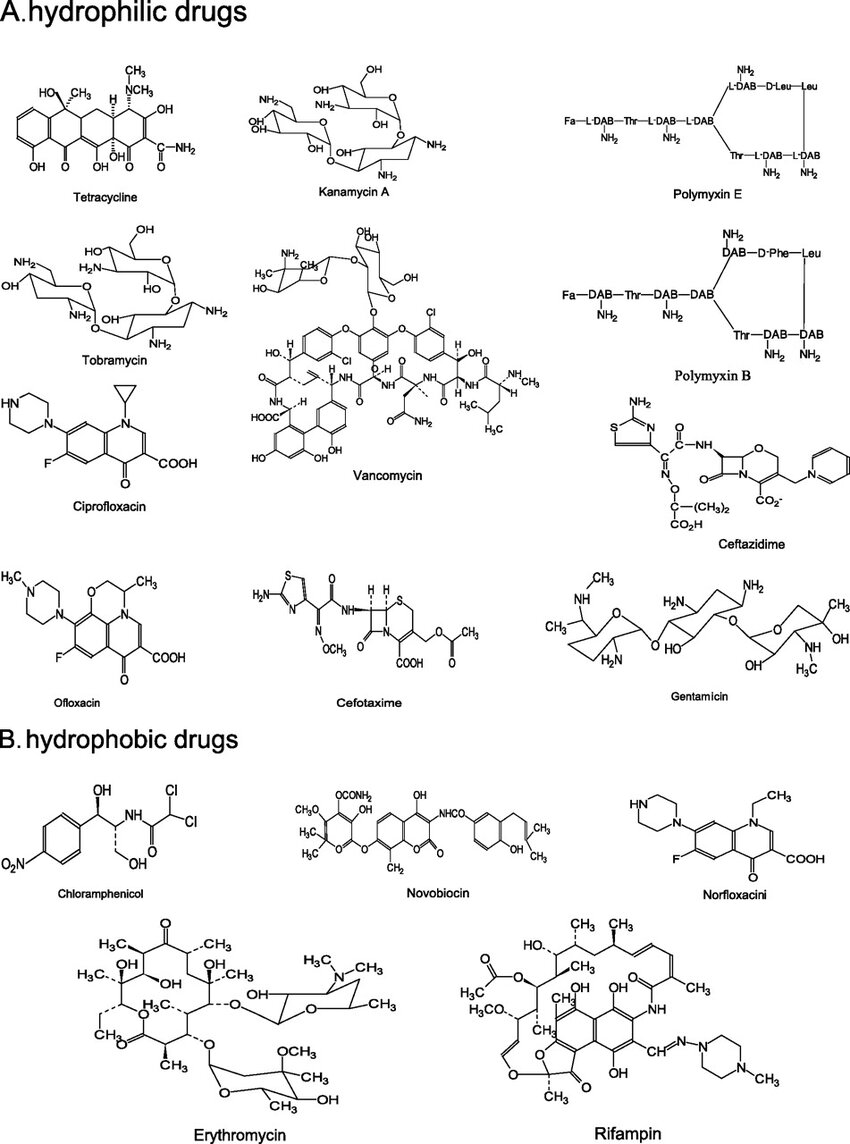
Chemical Structures of Some Common Anti-Biotics both hydrophobic and hydrophilic
Another category of Micro Pollutants are Endocrine Disrupting Chemicals.
Endocrine disrupting chemicals (EDCs) in cleaning products, like phthalates, PFAS, parabens, and synthetic fragrances, interfere with hormone systems. They are found in detergents, air fresheners, and softening chemicals. Chemically, they mimic hormones, blocking receptors (e.g., BPA as estrogen) or altering hormone production, impacting reproduction and development, with common examples including bisphenol A (BPA), phthalates (like DEP, DBP), and alkylphenol ethoxylates (APEs), often used as plasticizers or in fragrances.
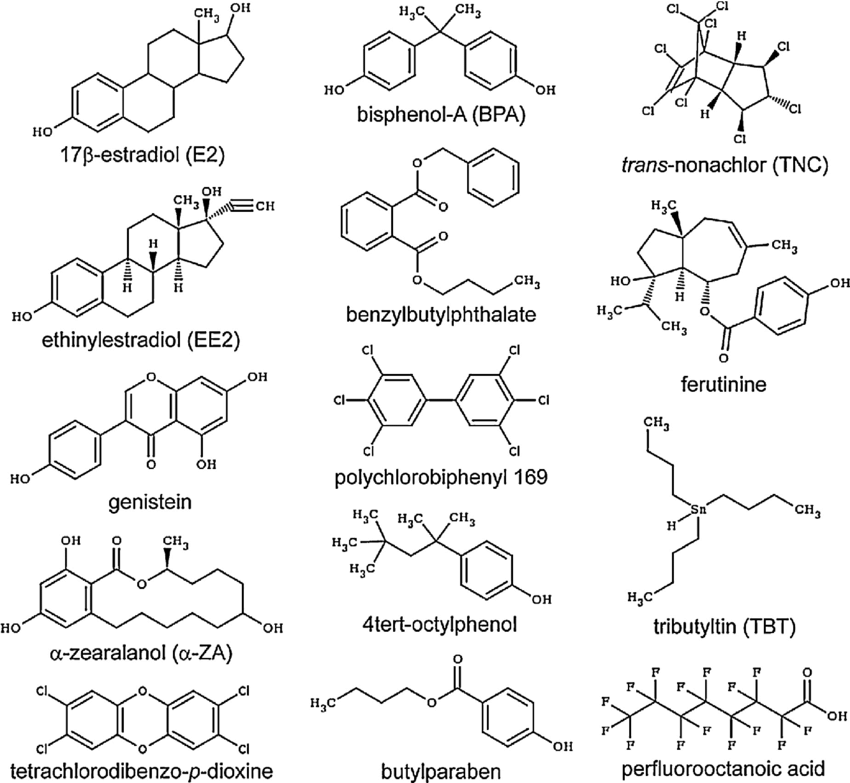
Chemistry of Typical EDC’s
For more info on PFAS, visit our PFAS page.
Pre-Requisite for the Fourth Treatment Stage
For the fourth treatment stage to be effective, you want to achieve an effluent that is low in SS, COD and TOC. Otherwise you will be overdosing Ozone that will react with background TOC and over-loading the GAC/PAC with background organics. Sand or cloth filtration before the Forth Treatment Step is advisable.
The Science Behind Activated Carbon Adsorption
Activated carbon isotherms for organics are graphs that describe the equilibrium relationship between organic pollutant concentration in water and the amount adsorbed onto the carbon, crucial for water treatment design, often using models like Freundlich, Langmuir, or more complex ones like SR (Summers-Roberts) for natural organic matter (NOM). They map adsorption capacity (mg/g) vs. equilibrium concentration (mg/L) and reveal how factors like carbon type, organic molecule size, and solution pH affect removal, with different organic compounds (e.g., humic acids, pesticides, antibiotics) exhibiting varied isotherm shapes (Type I-V), often showing strong hydrophobicity-driven adsorption.
Below is a fantastic article on this which is a subject that can take several PhD’s to master:
https://pubs.rsc.org/en/content/articlehtml/2023/ra/d2ra06436g
Finding isotherms for MP removal is next to impossible because the matrix is so complex but I managed to glean two open access articles on this topic from reputable Swiss and French sources:
Comparing the adsorption of micropollutants on activated carbon from anaerobically stored,
organics-depleted, and nitrified urine
Enhancing micropollutant removal efficiency using sustainable activated charcoal
Fourth Treatment Stage Plants in Germany
Germany is actively implementing fourth wastewater treatment stages (or quaternary treatment) in its Wastewater Treatment Works (WwTW/WWTP) to remove micropollutants, such as pharmaceutical residues, pesticides, and household/cosmetics chemicals, which are not captured by conventional (secondary/tertiary) treatment.
Westerheim (Swabian Alb): One of the first, operating since 2015 using Huber’s SANDFILTER CONTIFLOW®.
Uhldingen-Mühlhofen: Put into operation in 2023, representing one of Germany’s largest combined 4th treatment stage methods (ozonation and activated carbon).
Bickenbach: Put into operation in April 2025, considered one of the most modern in Hesse. The system integrates three main components: an upstream two-line cloth filtration (HUBER RotaFilt®) for pre-treatment, an ozonation stage to break down pollutants, and a four-line activated carbon filter (16 HUBER CONTIFLOW® GAC units) to adsorb remaining substances.
Tübingen: Inaugurated in 2021. The plant utilizes ozonation combined with downstream filtration (activated carbon).
The wastewater treatment plant (WWTW) in Mörfelden-Walldorf, Germany, utilizes an advanced four-stage process to remove trace substances like pharmaceuticals, pesticides, and industrial chemicals. The fourth treatment stage is based on Ozonation, powdered activated carbon adsorption and cloth filtration.
Fourth Treatment Stages in Switzerland
Switzerland introduced a mandatory fourth WWTW treatment stage requirement in 2016, while projects such as the one in Bickenbach WWTW’s in Germany have been implemented in the European Union on a voluntary basis and supported by subsidies.
The Villette wastewater treatment plant (WWTP) in Switzerland is a significant infrastructure project located in Thônex, Canton of Geneva. It is designed to handle population growth and, from 2023, has implemented the CarboPlus solution to treat wastewater and remove micropollutants.
AFRY (Pöyry Schweiz AG) is currently planning further micropollutant elimination stages at Swiss wastewater treatment plants Aire Geneva (1,000,000 p.e.), Bern (500,000 p.e.), Monthey-Cimo (500,000 p.e.), Kloten-Opfikon (125,000 p.e.), Rosenbergsau (110,000 p.e.), Lucens (70,000 p.e.), Delémont (50,000 p.e.) and Hinwil (30,000 p.e.).
References:
https://afry.com/en/insight/switzerland-pioneering-in-micropollutants-removal-wastewater
https://www.stereau.com/en/csr-initiatives/sustainability-at-the-heart-of-our-installations/
Fourth Treatment Stage Plants in Holland
- WWTP Emmen: Utilizes the BODAC® system, which combines BioActive® Carbon and Ozone Strong Water (OSW). BODAC = Biological Oxygen-Dosed Activated Carbon
- WWTP Winterswijk: Employs an O3+GAC (Ozone + Granular Activated Carbon) process.
- WWTP Leiden-Noord: Utilizes PACAS (Powdered Activated Carbon in Activated Sludge).
- WWTP Asten: Actively piloted the NanoX system, which combines nanofiltration and AOP/UV technology.
- WWTP Hapert: Used for pilot testing Upflow GAC filtration.
- WWTPs in the Regional Water Authority Vallei & Veluwe: (Specifically, the Bennekom WWTP, which has been used as a study site for effluent micropollutant removal).
- Utrecht (AGS plant): A full-scale Aerobic Granular Sludge (AGS a.k.a Nereda) plant in Utrecht was identified as a key location for studying micropollutant removal.
Case Study – SIAAP’s WWTW’s in Greater Paris Region, France
Seine Aval WWTW (in Achères) is Europe’s largest, treating WW from 6M people, with a treatment capacity of about 2.9 million m³/day (m³d) or 34 m³/s . It has 930,000 m³ in storm water storage basins and tank tunnels across its network. In comparison, Beckton, London Sewage Treatment Works (STW) has a flow to full treatment of approximately 27 m³/s, with peak storm flows reaching around 32 m³/s. The London Tidal Tunnel has a larger storm water storage capacity at 1.6 million m3 but the main WWTW’s in London, Beckton is very old and there is no disinfection step. Mogden and Crossness are more modern.
Raw sewage first undergoes initial screening (Eau Tamisee in diagram below), then enters large, covered settling tanks with lamellar Actiflo settlers to remove suspended solids, phosphorus, and some carbon pollution, also reducing odours.
80% of the Water moves to biological purification stages, including advanced biofiltration (Biostyr) to convert ammonia to nitrates (nitrification) and further remove carbon. Denitrification removes the nitrates and converts them into N2.
20% of the waste water is treated using MBR.
A % of the treated water is disinfected using UV lamps/PFA before discharge into the Seine river. Per Formic Acid is chosen for its superior disinfection performance and lower environmental footprint compared to traditional methods like chlorination, as it produces minimal harmful disinfection by-products (DBPs). The by-products of PFA are generally non-toxic to aquatic fauna at necessary dosages.
Based on recent upgrades as part of the Paris 2024 Olympic bathing plan, the Seine Valenton (Val-de-Marne) wastewater treatment plant has implemented UV disinfection capabilities for its treated effluent, enabling it to disinfect a large portion, with the goal of treating 100% of its dry-weather flow (up to 600,000 m3/day with UV, particularly for pathogen removal before discharge into the Seine. The Capacity of the WWTW’s is 600,000 m3/day dry weather, and up to 1,500,000 m^3/day in rainy days.
Target: The recent UV installation aims to treat the effluent, reducing bacteria levels to meet safety standards for recreational water use (bathing).
Sludge is digested in AD’s which generate biogas (methane-rich), which is treated, captured and utilized for combined heat and power (CHP) or injected into the grid, making the plant an energy producer.

Seine Aval WWTW Processes for the Greater Paris area
References:
https://www.siaap.fr/siaap-greater-paris-sanitation-authority/
Case Study: Henriksdal Wastewater Treatment Plant, Stockholm
Henriksdal Wastewater Treatment Plant uses a multi-stage process, including preliminary screening/grit removal, primary settling, biological treatment with advanced Membrane Bioreactors (MBRs) for deep nutrient removal, secondary settling, filtration, and disinfection, plus sludge digestion for biogas, all while undergoing a major upgrade to handle Stockholm’s wastewater, becoming cleaner and more efficient by 2029. MBR removes up to 99.999% of bacteria and viruses from the waste water.
Membrane Bioreactors (MBR) generally remove antibiotics from wastewater, typically outperforming conventional activated sludge systems, with average degradation and adsorption rates often exceeding 70% for many compounds. Removal efficiency depends on factors like specific antibiotic chemical structure, sludge age, and retention time.
The Singapore Case
Singapore’s Wastewater Treatment Works (WWTW) system effectively includes advanced treatment stages that function as a fourth stage (or advanced treatment/reclamation) to produce high-grade reclaimed water known as NEWater. It polishes treated WW effluent using RO.
Very few organic molecules can pass through an RO membrane:
- Alcohols: Ethanol, methanol.
- Phenols: Some simple phenolic compounds.
- Solvents: Certain volatile organic compounds (VOCs).
Benefits to the Environment and Public Health
Reduction of Antimicrobial Resistance (AMR): The technology (activated carbon, ozonation, or membrane processes) helps to remove resistant bacteria and genes, reducing the risk of “superbugs” in the environment.
Specifically, studies of the Geräthsbach stream in Hesse, Germany — which receives effluent from the Mörfelden-Walldorf plant—showed that the fourth stage improved the fertility of organisms and enabled many sensitive species to return within as little as two years from start of treatment.
Below is the impact assessment of the European Commission in regards the Updated Urban Waste Water Treatment Directive:
https://kremesti.com/wp-content/uploads/2026/01/Impact_assessment_accompanying_the_EU_UWWTD.pdf
Conclusion
Fourth Water Treatment stages are the future. Our rivers are polluted world wide and we need to upgrade our WWTW’s before the next superbug epidemic breaks out. Active Carbon and Ozone companies are poised for significant growth.
The UK is falling behind the EU in implementation of the updated urban Waste water treatment directive. The Updated EU UWWTD will have a five fold impact:
- Phosphorus recovery has been mandated by the UWWTD to close the phosphorus loop essential for life. This will boost the business of large water treatment companies that have the technology to recovery phosphorus. Paques, Veolia, Suez will see a boost in sales.
- Banning WWTW sludge application to agricultural fields will boost the business of German and Swiss suppliers of sludge drying and incineration technology.
- Implementing the Extended Producer Responsibility clause to manufacturers of pharmaceuticals and cosmetic products that pollute the environment and making them majority fund Fourth Treatment Stages on large urban WWTW’s.
- Suppliers and producers of Activated Carbon and Ozone production/dosing systems will see a rise in orders.
- Water quality in rivers, lakes and beaches that receive treated effluent from WWTW’s will see an improvement while in the UK water quality will deteriorate and the risk of superbug epidemics/deaths will be higher.
About The Author
Rami Elias Kremesti is a UK chartered water and waste water treatment specialist that is passionate about the science and technology of water treatment and environmental protection. He has worked on water treatment projects worldwide and has twenty years of experience in the industry. He loves to solve a good technical problem and to teach and inspire the next generation of environmental professionals. If you enjoy these informative pages, please give us a good review on Google.

Rami Elias Kremesti Portrait