Reverse Osmosis:
One Of the Most Important Desalination and Water Recycling Technologies of the 20th/21st Century
by Rami Elias Kremesti M.Sc., CSci, CEnv, CWEM
Kremesti Environmental Consulting Ltd
Transmutare Substantiarum Basium In Aurum TM
Introduction
Reverse Osmosis or simply RO is one of the water treatment technologies that I am most passionate about. And who wouldn’t be interested in a polymer membrane which when seawater is pushed hard enough through it, potable water comes out the other end? I mean Jesus turned water into wine but RO technology can turn seawater into drinking water !
RO technology is used to desalinate water, but as a corollary, the “reject” stream in effect concentrates the salts in the treated water so it can also be used to concentrate brines like Lithium brines for example. With the development of recovery technologies, RO is becoming more and more sustainable as the brine reject it generates can be used for chemical recovery.
Most RO systems are Spiral Wound but DTRO systems are based on a stack-disc design.

Typical Spiral Wound RO Membrane
Reverse Osmosis (RO) technology was developed at UCLA by Sidney Loeb and Srinivasa Sourirajan, who, under Professor Samuel Yuster, created the first practical cellulose acetate membrane in 1959, enabling efficient water desalination by allowing fresh water to pass while rejecting salt. Their ground breaking work, first demonstrated in a Coalinga, California plant in 1965, made large-scale, affordable freshwater production from saltwater possible, thus revolutionizing water treatment.
Applications:
RO technology has applications in producing potable water from seawater and brackish water, purifying water for industrial processes like power generation and semiconductor manufacturing, and treating wastewater for reuse. It is used across many sectors, including food and beverage, pharmaceuticals, electronics, and healthcare, to provide purified water for everything from ingredient mixing and boiler feed to dialysis and equipment cleaning.
Industrial and manufacturing applications
Electronics manufacturing: Provides ultrapure rinse water for semiconductor production to prevent contamination.
Pharmaceuticals: Creates ultrapure water for drug formulation, water for injection, cleaning, and sterilization.
Food and beverage: Used for purifying ingredients, concentrating juices, pre-concentrating milk and whey, and de-alcoholizing beverages.
Power plants: Produces high-purity water for boilers and other processes to ensure efficient operation.
Chemical and Petrochemical: Generates high-quality process water for various chemical plants, oil refineries, and petrochemical complexes.
Other applications
Healthcare: Used in hospitals for sterilization and in dialysis machines.
Hospitality: Provides clean drinking and cooking water.
Car washes: Supplies low-TDS (total dissolved solids) rinse water to prevent spotting.
Aquariums and zoos: Maintains specific water parameters for aquatic life.
Green hydrogen production: Used to create high-purity water needed for the process.
Lithium brine purification: Separates and purifies lithium from brine solutions.
My Experience with RO Technology
I started working with RO systems in 2007 in Bulgaria at a coal fired power station. Surface water was treated in a 3 stage RO to create desalinated water which was then completely demineralized using a Mixed Bed Ion Exchange system (MBX) to create ultra-pure water for the boilers. It had an excellent classical pre-treatment system and with regular CIP’s (Clean In Place), the membranes lasted 10 years.
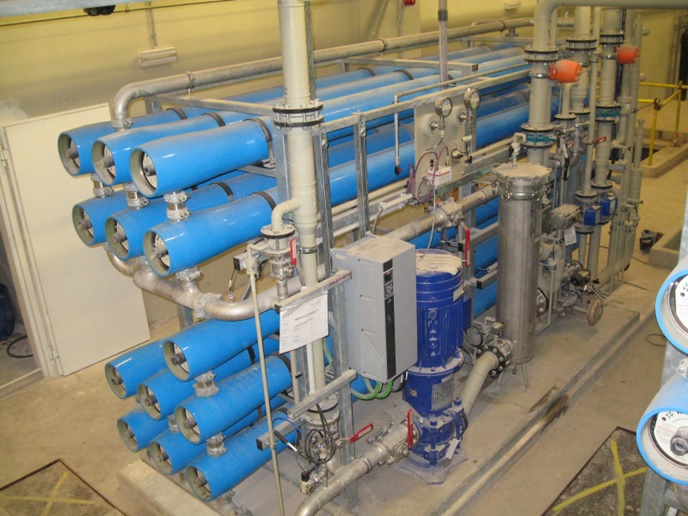
Three Reverse Osmosis Skid at Galabovo Power Station in Bulgaria
Problems That RO Technology is Prone To
RO’s are awesome but they are prone to fouling (silt, colloids or organic fouling), scale, and biofouling. So a carefully designed water pre-treatment system is needed to minimise these phenomena and sometimes you just have to live with them and manage them through good operations practices. Good O&M practices are also vital. A Clean-In-Place or CIP skid is vital for the continual operation of an RO system.
When an RO system starts to show signs of increasing normalized pressure or decreasing flow, conduct a troubleshooting and then decide if a cleaning is in order. Have a look at our RO Cleaning Chemicals document. We also have a presentation on performing autopsies on RO membranes.
Types of scale that RO is prone to:
Reverse Osmosis (RO) systems are prone to scaling from common mineral precipitates like Calcium Carbonate (CaCO3), Calcium Sulfate (CaSO4), Barium Sulfate (BaSO4), and Silica (SiO2), forming deposits that clog membranes, with calcium carbonate being the most frequent, often controlled by pH adjustment and anti-scalants, while silica and sulfates are harder to remove, requiring pre-treatment or careful monitoring and anti-scalant dosing.
Magnesium silicate scale on reverse osmosis (RO) membranes is difficult to clean. Silica and metal-silicate scales in general are known for their hard, glass-like texture and are less soluble in standard cleaning agents (ordinary acids and alkalis) compared to other common scales like calcium carbonate.
DTRO -Disc Tube Reverse Osmosis
Disc Tube Reverse Osmosis is an RO membrane based technology designed specifically for high-fouling, high-salinity, and viscous wastewaters like landfill leachate. Unlike spiral-wound RO elements, DTRO uses flat sheet membranes arranged between plastic disc spacers inside a pressure vessel, creating wide and turbulent flow channels.
DTRO technology for leachate treatment was initially developed by German RTS ROCHEM, building on a plate-and-frame open channel (no spacer) modular design from the German GKSS research center (renamed Hereon), but its widespread application, refinement, and commercialization in leachate treatment, is seen mostly in China. DTRO can handle high SS and SDI waste waters without expensive pre-treatment. The individual membranes can be removed, inspected, and replaced as needed.
Its main disadvantage compared to spiral wound RO membranes is that it has a much smaller surface area per module.
Here is a very interesting article by Dr. Thomas Peters on Landfill Leachate treatment that uses a combination of HydroCyclone, Crystallization and DTRO Technology.
https://www.defrawater.com/landfill
https://www.linkedin.com/in/dr-thomas-peters-77964834/
https://www.rts-rochem.de/wp-content/uploads/2015/05/leachate-leaflet-20-01-152.pdf
https://wta-unisol.com/en/products/dt-disk-tube-reverse-osmosis/
https://www.sciencedirect.com/science/article/abs/pii/S0048969721033623
Manufacturers of RO Membranes
The most reputable RO membrane manufacturers are DOW/DuPont’s Filmtech, Hydranautics , Koch (Kovalus), and TORAY. The Koreans are also starting to make good RO membranes with their LG brand. The Chinese are catching up fast with their Vontron brand.
Not only can they treat Brackish and Seawater, RO’s are starting to be used to treat tertiary Sewage effluent as well as industrial effluent such as mining waste water which can sometimes contain heavy metals. Many cooling towers can recycle some of their blowdown using RO technology.
Suppliers of Mega SWRO Plants
Suppliers of mega desalination sea water RO plants include:
IDE
DOOSAN
Veolia
Hyundai Engineering & Construction
Acciona
Engie
Suppliers of Small to Medium Size RO Systems
SOCOTEC
Wycombe Water
Culligan
EuroWater

RO System Photo
RO System Design
RO system design uses RO Projection software which is normally free to download from the RO membrane supplier and this software creates a projection based on the water chemistry which calculates the needed feed pressure as well as things like the need for pH correction or dosing an anti-scalant. Download our presentation on RO Software Projections.
RO’s produce a reject stream also called brine and for sea water RO, it is pretty salty and people worry about its environmental impact when discharged to the environment. However, the technology is constantly evolving and Ultra High Pressure RO can now squeeze more water out of the brine. It works with pressures up to 120 bar !
A proper pre-treatment and biofouling management strategy is crucial for trouble free RO operation. Download out presentation Introduction to Reverse Osmosis for more info.
RO Operations and Maintenance
RO Operations requires careful monitoring of RO system parameters on a daily and weekly basis. When the RO systems shows signs of decline in performance, proper maintenance needs to be performed which normally includes a CIP.
Download our detailed presentation on RO DOM: Design, Operations and Maintenance. Our presentation on Software Projections might also be useful.
RO Technology Training
All these interesting topics I teach in my Complete Water Treatment Course or if you choose you can sign up for CIWEM’s Introduction to Reverse Osmosis course which I developed and also tutor. Also make sure you have a look at my free RO presentations on the homepage.
Innovations in RO Technology
High tech RO membranes are always coming on the market and new system design strategies are being used to constantly improve RO systems. Below is a schematic of a design strategy to improve SWRO systems by using different types of RO membranes within the same pressure vessel as well as the Split Partial Second Pass process.
Intra-Vessel Staging

Intra Pressure Vessel Staging and Using Membranes With Different Fluxes
PFRO
Other innovations in RO technology include IDE’s Pulse Flow RO (PFRO) in which the RO membrane is pressurized with brackish water in dead end mode (i.e reject valve completely closed) in batches and for specific periods of time then the reject is released. The cycling is not favourable to biofilm growth due to changing osmotic pressure and the pressurized water is also released before the induction time of scaling compounds so scale does not form without the use of anti-scalants.
DOHS – Direct Osmosis High Salinity
DOHS (Direct Osmosis – High Salinity) is an innovative, chemical-free membrane cleaning technology for Reverse Osmosis (RO) systems, using a brief, concentrated brine injection to reverse water flow on the membrane (creating forward osmosis/direct osmosis from the permeate feed side of the membrane) that dislodges foulants (like minerals, organics, biomass) and restores membrane performance, allowing for online cleaning without shutting down the RO plant.
Graphene Oxide or GO RO Membranes
The introduction of Graphene Oxide into the RO membrane is an ongoing area of research with the goal being to form ion-channels that are specific to water that will reduce operating pressures.
BioPhree Pre-Treatment for RO
The Dutch have developed a technology for phosphorus removal called BioPhree. It can bring Total P down to 15 ppb at which level the water becomes Bio-Stable. This will minimize access to essential P nutrients for biofilm formation and consequently retard Biofilm formation. DOW used to market something similar called BeFree but they pulled it from the market.
BODAC
BODAC (Biological, Oxygen-Dosed Activated Carbon) is used as a pre-treatment for Reverse Osmosis (RO) to prevent biofouling. It combines the biological activity of a bio-activated carbon (BAC) filter with the addition of oxygen to promote nitrification and oxidation of pollutants. This process effectively removes organic matter, nutrients, manganese, and other fouling precursors, leading to a more stable and biologically stable feedwater for the RO membranes, which extends their lifespan and reduces maintenance costs.
How BODAC works for RO pre-treatment:
Biological activity: The activated carbon is colonized by a biofilm of microorganisms that break down contaminants.
Oxygen dosing: Oxygen is added to the water flowing through the filter to encourage aerobic reactions, such as nitrification, which converts ammonium to nitrate.
Fouling prevention: The biological and oxidative processes remove a wide range of substances that can cause RO membrane fouling, including:
– Organic micropollutants (OMPs)
– Nutrients like ammonium and nitrite
– Manganese and iron
– Particulate organic compounds
Benefits of using BODAC
Reduces RO membrane fouling: This is the primary benefit, leading to a longer membrane lifespan and less frequent replacement.
Lowers chemical use: It reduces the need for other chemicals like biocides, flocculants, and cleaning agents.
Improves water quality: It significantly lowers the concentration of soluble organics and other pollutants, ensuring a more stable water supply for RO.
Cost-effective long-term: While initial investment costs can be high, they are offset by long-term savings in operational expenses and chemical costs.
Example application:
An ultra-pure water (UPW) plant in Emmen, Netherlands, has used a combined ultrafiltration (UF) and BODAC pre-treatment for over a decade to prevent RO membrane fouling. Their original RO membranes are still in operation after more than 11 years due to this effective pre-treatment.
Using Capacitive Deionization (CDI) as a pre-treatment for Reverse Osmosis (RO) can increase overall water recovery and reduce energy consumption in systems treating high-salinity water or RO brine. CDI removes dissolved salts before the water reaches the RO membrane, which reduces the RO system’s load and fouling, allowing it to operate more efficiently.
Technologies that Compete with Reverse Osmosis In Water Desalination and Brine Concentration
Forward Osmosis
Multi Stage Flash Distillation
Capacitive De-Ionization
Electro-Deionization EDI
SonixED claims to desalinate seawater with 50% less power than RO:
https://sonixed.com/technology
RO System Monitoring ASTM Standards
ASTM D4516: Standard Practice for Standardizing Reverse Osmosis Performance Data
Purpose: Provides a method to adjust field data (flow, rejection) to a standard set of conditions (temperature, pressure) for accurate comparison and troubleshooting.
Covers: Permeate flow, salt passage, and coefficient of performance.
ASTM D4195: Standard Guide for Water Analysis for Reverse Osmosis and Nanofiltration Application
Purpose: Guides the analysis of feed water to understand its impact on RO/NF performance (salt rejection, salt passage, flow, scaling, biofouling).
ASTM D3923: Standard Practices for Detecting Leaks in Reverse Osmosis Devices
Purpose: Methods to find leaks in RO systems, crucial for accurate performance data.
ASTM D4472: Standard Guide for Recordkeeping for Reverse Osmosis and Nanofiltration Systems
Purpose: Ensures consistent and useful data collection for system management.
ASTM D4194: Standard Test Methods for Operating Characteristics of Reverse Osmosis Devices
Purpose: Covers how to determine operating characteristics like permeate flow and salt passage.
ASTM D2332, Standard Practice for Analysis of Water-Formed Deposits by Wavelength-Dispersive X-Ray Fluorescence.
This standard is a general practice for the analysis of “water-formed deposits” and can be adapted for analysing the elemental composition of scales/deposits removed from membranes, though it is not specific to RO membranes.
The Business Case or Economics of RO Technology
The typical owner’s total life cycle cost of potable water produced by mega Seawater Reverse Osmosis (SWRO) plants typically ranges from $0.40 to 1.20/m³, with some very recent projects achieving record-low costs due to economies of scale and technological advancements.
References
NEWater Singapore
Newater China
Getting_the_most_out_of_your_RO_Lenntech
Dow’s Filmtech Manual
Vision for the Future
Our vision at Kremesti Environmental Consulting, is a world in which water treatment is treated at the Point of Use because centralized mega water and waste water treatment plants simply cannot cope with the expansion of mega cities. Imagine a network of decentralized waste water collection and treatment systems… We collect and recycle our trash, it should be the same with our waste water… New home builds should collect their own rain water and reuse it/water gardens with it/inject it into the local aquifer. They could be able to produce their own drinking water. Ultimately, they should offset their own carbon footprint too by planting/caring for trees.
Additionally, users should separate grey water from sewage and treat both on site. This would lead to a significant reduction of the strain on sewage collection networks and centralized mega WWtW’s. This is already happening in industry. Many water scarce regions require of their industries to be ZLD – Zero Liquid Discharge.
Conclusion
If you are replacing RO membranes too often, say once every 6 months, know that it is highly likely that something is wrong with the pre-treatment system. Sometimes an RO Autopsy is needed which will tell you what is causing the failure. Sometimes just looking at the water chemistry is enough to predict what is causing the problem.
Many countries that have access to seawater with arid climates and low rainfall rely on RO technology to desalinate seawater and produce drinking water. For example, Saudi Arabia and Israel. Spain and Greece too. In fact, Israel is home to IDE, one of the most innovative companies when it comes to RO technology. I met the CTO in 2023, Dr Boris Lieberman, who was the engineer that designed the first RO system for the Kremlin in Moscow.

Dr Boris Liberman CTO of IDE
I hope I have piqued your interest in RO Technology. Any one with questions/RO issues feel free to ask, or for clients seeking consultations, send an RFI/RFQ.
Kind regards,
Rami Elias Kremesti M.Sc., CSci, CEnv, CWEM
a.k.a RamiRO
Your RO Technology Expert Consultant
Biography of the Author:
Rami Elias Kremesti is a chartered water and wastewater treatment specialist with a background in chemistry. He has worked on a myriad of water treatment and power station projects internationally. He is a British Citizen based out of High Wycombe, UK. He has published three books on philosophical topics which he loves to ponder in his spare time.
If you found this page useful, please leave us a positive review on Google.

Rami Elias Kremesti Portrait